01 · Goals
Mission, objectives, and key results — mapped in a hierarchy where every task connects back to the outcome it serves.
→ live in graph
Every decision Humfrid makes is grounded in your business — and gets sharper with every action.
Everything your team learns, decides, and reasons through — kept, connected, and ready the next time it matters.
Goals, customers, code, principles, decisions, and product — structured, linked, and understood by Humfrid.
Mission, objectives, and key results — mapped in a hierarchy where every task connects back to the outcome it serves.
Every customer, every conversation, everything they've said — connected. Not a CRM field. The actual signal, attached to the person who gave it.
Your codebase as a graph, not a directory. Every function mapped to the decision that shaped it. Every change scored for blast radius before it lands.
The rules your team operates by, learned from how you actually work. New decisions get measured against them automatically.
The calls your team has made, and why. Context and tradeoffs logged and carried forward. No re-litigating settled questions.
Every feature, what users have said about it, and the decisions that shaped it. The full history of why the product looks the way it does.
Most tools store. Humfrid understands.
$ |Text, voice, PDF, DOCX, PPTX, Excel, HTML, CSV, email. If you have it, we parse it.
Upload audio files and get automatic transcription that knows who said what. Voice-to-context in one step.
Slack threads, Jira tickets, Google Drive — with full attribution preserved. Changes sync automatically.
Raw text → atomic facts → named entities → deep extraction of what’s been decided, assumed, and learned.
Every statement automatically categorized — data point, lesson learned, decision, or guiding principle. With category, author, title, and tags detected automatically.
Mentions of people and companies resolve to the right entity automatically — even across nicknames, typos, or partial names.
Semantic deduplication before anything enters the graph. Upload the same content twice? Caught automatically.
Define your actual product: features, capabilities, user segments, accounts. Every data point lands in the right context automatically.
Track who said what — and how confident they were. Was it a firm decision, a working assumption, or someone’s gut feeling? Every piece of context carries its source and certainty level.
Every decision links back to the research and signals that shaped it. You can always see why a call was made — not just what it was.
Context isn’t stored in isolation. Each piece connects to others — building on, supporting, contradicting, or replacing what came before. The relationships are explicit, not implied.
What you learned yesterday is still there tomorrow — across every agent. Just pick up where you left off and watch your agents get smarter every day.
Entity-aware semantic search across everything your team knows. Ask about a person, project, or decision and get precise answers with sources.
Under the hood
Discrete data entities with derivation chains and provenance. Every decision, principle, signal, and goal traces back to the source it came from — and forward to everything it influenced.
Every atom shows where it came from and what it's derived from. A decision traces to the meeting it was made in. A principle traces to the five decisions that revealed it.
Every claim is backed by its source — the exact sentence in the transcript, the message in the thread, the line in the doc. Click any atom, see the receipt.
Atoms evolve as your team does. A decision that gets revisited isn't overwritten — it's versioned, with the reasoning for the change captured alongside it.
Go with per-seat pricing over usage-based model.
Reason: usage-based created unpredictability for finance teams. Per-seat easier to budget.
Per-seat pricing.
Usage-based pricing. Revisited after customer interviews showed budget friction.
When a new decision contradicts an existing principle or data point, agents flag it immediately — while it still costs nothing to fix.
“Build advanced dashboard analytics — prioritized for Q2.”
“Analytics never mentioned in 7 of 10 recent customer calls. Search was #1.”
Keeps track of your objectives and metrics, maps the opportunity space, identifies solutions, and suggests how to implement them.
No dashboards to check. No meeting summary you forgot to read. When something matters, Humfrid tells you — wherever you already are.
Humfrid lives in Slack and plugs into the tools your work already runs on — so there's no new place to check.

Quick follow-up on the activation goal — the onboarding tour you shipped two weeks ago is paying off. Activation's up 3pp since launch (41% now), so you're nearly halfway to the 45% target and a little ahead of pace.
@Humfrid nice! should we double down and add a second tour step?
Worth thinking about both sides. I just checked our funnel analytics — people who finish the tour activate about 19% higher (last 1,200 sign-ups), so there's clearly value in it. But 22% drop off on step 1, and a second step would probably make that worse. I'd tighten step 1 first before adding to it. Should I add it as an opportunity and write a brief?
@Humfrid yes let's do it!
nice work team! 🎉
 Linear
  GitHub
  Google Analytics
  Slack
Slack  Figma
Figma  Google Drive


Through MCP, every coding agent your team runs pulls its brief straight from Humfrid — the objective, the decisions, the specs. So what they build is what you meant.






Humfrid helps you move from signals to shipped to impact, with confidence and ease.
Every click, user interview, and online review — read continuously, the moment it happens. Nothing worth knowing slips past.
Scattered signal becomes a tree of opportunities — each one traceable to the evidence behind it. You see the reasoning, not a black-box score.
The work to capture it gets planned, delegated, and built — by your team and your agents, all from the same shared context.
How success will be measured is defined before anything ships. Then the metric is watched automatically — no dashboard to remember to open.
What worked feeds the next move. What didn't, too. The loop comes back around sharper every time — and never forgets why.
Finally, the hardest job in tech gets easier. Humfrid helps you move from signals to shipped to impact, with confidence and ease.
When your engineers ship faster, it becomes more important than ever to stay on top of goals, customers and data. Humfrid makes sure you do.
Product managers spend most of their time chasing information instead of deciding.
Data, customer learnings, previous decisions, product principles, goals and plans — searchable and queryable from one place.
Product managers create plans, PRDs, and tickets with LLMs — with mediocre results.
Impactful plans, PRDs, and tickets grounded in your shared context.
Product managers spend endless hours in alignment meetings.
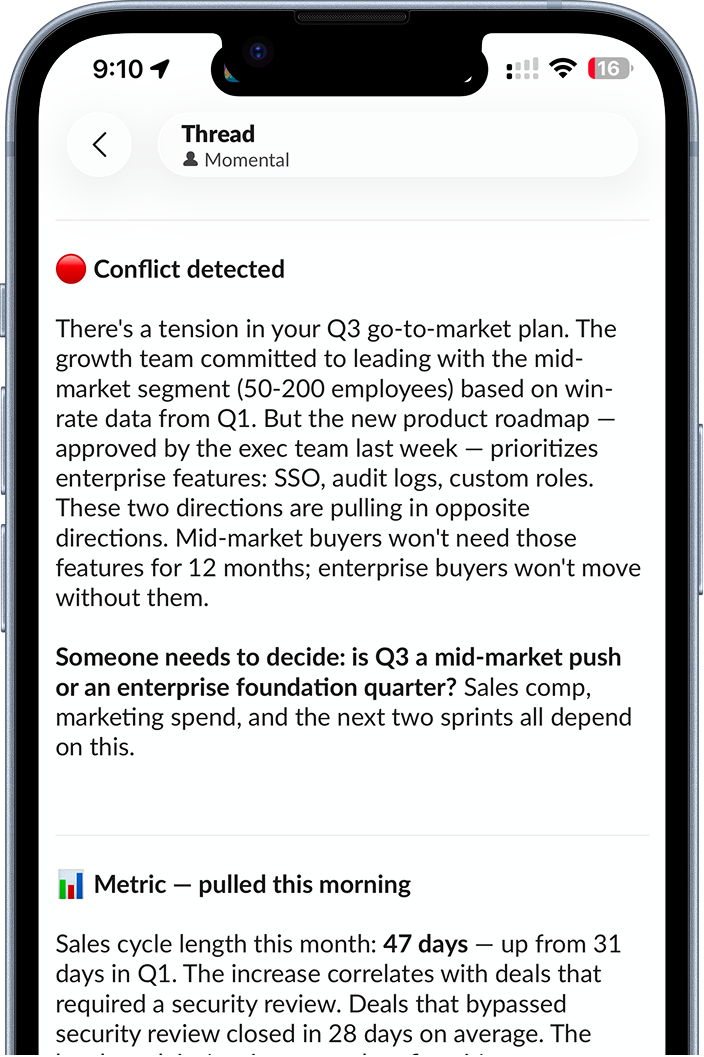
Humfrid alerts you when your decisions don't match the data, or when another team is making conflicting plans — so you can course-correct immediately.
Engineers ship the wrong thing faster than ever.
Claude Code and Cursor read your product context through MCP before they write a line of code.
You only discover in QA that engineers built the wrong thing.
Every PR is reviewed to make sure it adheres to what customers want, product decisions, and team principles.
You can't tell whether the AI-built feature actually worked.
Every shipped feature is automatically measured against the outcome it was built to impact.
You run experiments to learn, but struggle to systematically apply the learnings to your next bet.
Every learning flows back into your shared context, so every team and agent builds on it. Insight compounds with each bet.
Conflict detection
Standups, planning docs, OKR reviews — meetings that exist because context doesn't travel on its own. Humfrid makes it travel. Misalignment caught — explicit and implicit — at authorship, not at launch.
Humfrid flags when a new decision contradicts what customers have told you. You hear it in the planning doc, not six weeks after shipping.
Your team agreed that every new feature ships behind a flag until validated. A new PRD quietly skips the flag. Humfrid catches it immediately — not after the rollback.
Two teams, two decisions, two directions. Humfrid catches the drift the moment the second decision is written — while it still costs nothing to reconcile.
Code intelligence
Humfrid indexes your code alongside your decisions, principles, and customer signals — so the "why" and the "what" finally are connected.
Every function, every caller, every downstream dependency — indexed and queryable in milliseconds. Your agents stop reading 20 files blind and start with the answer.
Risk level on every change. All surfaced before the edit, not after the regression.
The "why" lives next to the "what." When an agent proposes raw SQL, it sees the team already decided to use the ORM. Architectural drift, caught at authorship.
Two agents editing the same file used to be a merge conflict waiting three hours to happen. With Humfrid, they see each other the moment they both reach for the same symbol.
Humfrid is the friendly product agent that helps your team spend time on what matters.
Free to start · No credit card